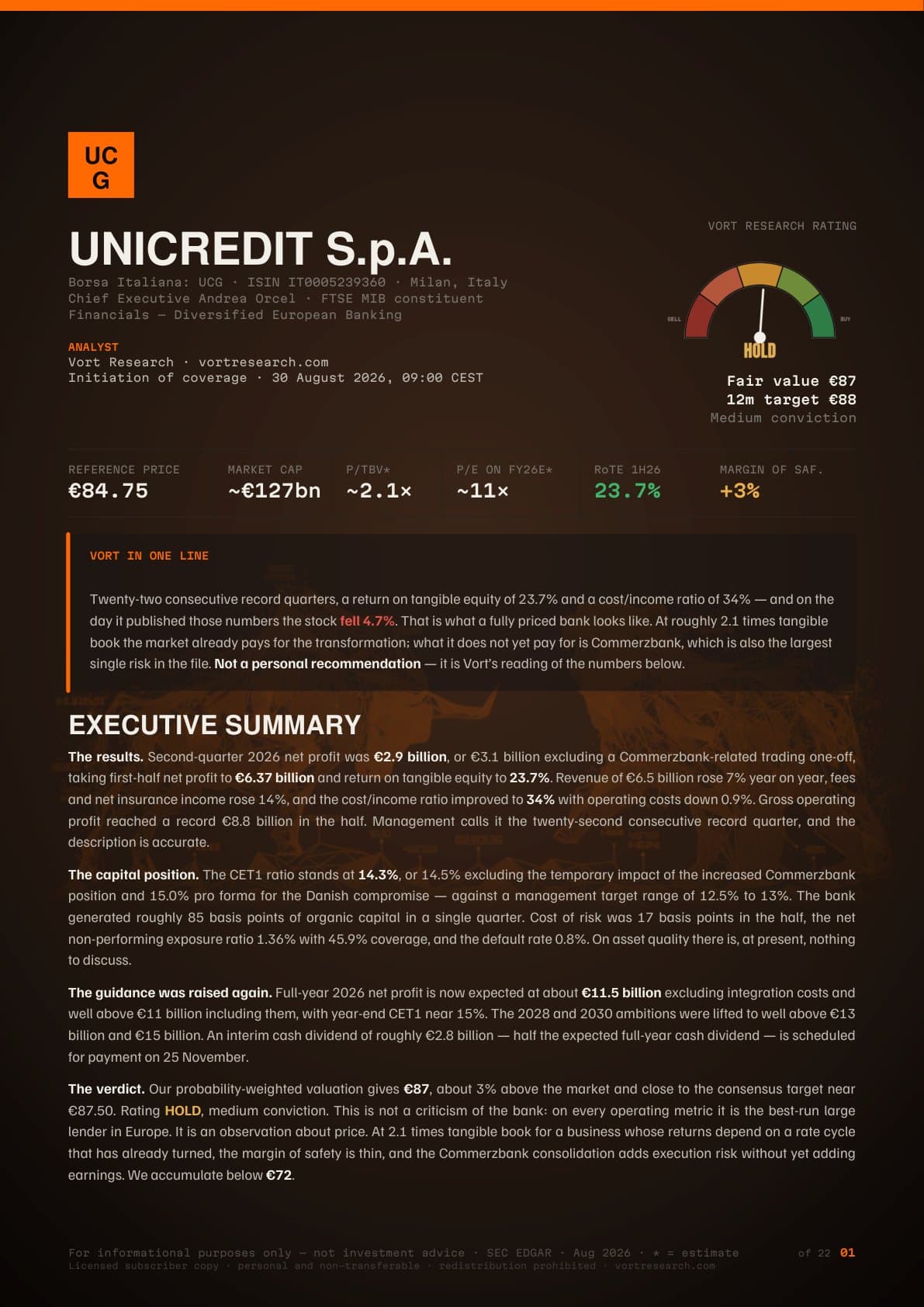
Twenty-two consecutive record quarters, a 23.7% return on tangible equity and a 34% cost/income ratio — and on the day it published those numbers the stock fell 4.7%. At 2.1 times tangible book the market already pays for the transformation.
Live quotes cover US listings only: for this share the price is the report’s, dated August 30, 2026, and the upside is measured from it. The fair value is the report’s, dated August 30, 2026; it does not move with the market. Vort Research provides informational and educational content. It is not personalised financial advice nor a solicitation to invest.
The full report is for Vort+ members.
The rating, the fair value and the reasoning on this page are public. The PDF and the slides download with Vort+; if you already have it, sign in.
First-half net profit of €6.37bn, return on tangible equity of 23.7% and a cost/income ratio of 34% — best in class in Europe, and roughly twice the cost of equity. Management calls it the twenty-second consecutive record quarter, and the description is accurate.
The price already says so.
At about 2.1 times tangible book the market pays in full for returns that sit at a cyclical peak: cost of risk at 17 basis points, rates still elevated, costs already cut. On the day those record numbers were published the shares fell 4.7%.
Commerzbank is the swing factor, in both directions.
It is the largest cross-border bank consolidation Europe has attempted in a generation. It is also what spends the capital surplus — CET1 from about 15% to the 13% area — and the management attention that made the machine run.
return on tangible equity, 1H26
23.7%
cost/income ratio
34%
CET1, against a 12.5–13% target
14.3%
total distribution yield
~7.5%
The accounts in brief
First half 2026, reported 23 July
Net profit FY26E
~€11.5bn
↗ rising: +8%
Net profit FY25
€10.6bn
↗ rising: +14%
Net profit 1H26
€6.37bn
Revenue 1H26
€13.4bn
Gross operating profit 1H
€8.8bn
↗ rising: record
RoTE FY26E
~22%
↗ rising: from 19.2%
Cost of risk 1H26
17bps
Net NPE ratio
1.36%
45.9% coverage
The analysis
Free summary
The machine, and why it runs
Revenue of €6.5bn in the second quarter rose 7% year on year, with fees and net insurance income up 14% and operating costs down 0.9%. That combination — growing revenue against falling costs — is what takes a cost/income ratio to 34%, and it is why the returns are where they are.
Capital that has nowhere obvious to go
CET1 stands at 14.3%, or 15.0% pro forma, against a management target of 12.5–13%: roughly €10bn of surplus capital. The bank generated about 85 basis points of organic capital in a single quarter. Surplus of that size is either distributed or spent — and Commerzbank is the proposal to spend it.
Why the fifth force is regulation
For a bank the competitive threat that matters is not substitution but the regulator. Capital requirements, the treatment of insurance holdings, national approval of cross-border deals and the Italian banking tax all move earnings directly, and are all decided outside the company. The 2025 capital decline was driven entirely by one-off regulatory and tax impacts.
The bank has never worked better. The price already says so.
Vort Research — UniCredit initiation, 30 August 2026
What it does, and how it earns
The business
UniCredit is a pan-European commercial bank built around Italy, Germany, Austria and central and eastern Europe. It lends, collects deposits, and increasingly earns fees from asset management, payments and insurance — the part of the revenue that survives when rates fall.
Where the revenue comes from
Italy — the home market–share not given
Germany — HypoVereinsbank–share not given
Central Europe — Austria and neighbours–share not given
Eastern Europe–share not given
The model
A bank does not have enterprise value or free cash flow in the industrial sense: debt is its raw material, not its financing. It is valued on the relationship between return on tangible equity and cost of equity, expressed as a justified multiple of tangible book.
The Vort verdict in four lines
This is a qualitative summary and not a recommendation.
Operations
✓Best in class
34% cost/income and 23.7% RoTE: no large European bank currently does better.
Capital
✓Strong
CET1 14.3% against a 12.5–13% target, with cost of risk at 17 basis points.
Valuation
×Fully paid
2.1x tangible book for returns at a cyclical peak leaves a thin margin of safety.
Commerzbank
±Unresolved
Accretive if it works, and the end of the capital surplus either way.
Who it competes with
Company
Where it competes
UniCreditThis stock
Pan-European commercial bank — Italy, Germany, CEE
Intesa Sanpaolo
The other Italian large-cap, more domestic and fee-heavy
BNP Paribas
The European scale comparator, lower returns on tangible equity
Banco Santander
Retail scale outside Europe, different risk profile
Commerzbank
The target: German retail and Mittelstand lending
Deutsche Bank
The other German option, still rebuilding returns
European banks are emerging from the rate cycle with capital to deploy, which is the same force that makes Commerzbank contested. Rivalry is intensifying at exactly the moment the sector has the money to act on it.
How we value it
The number and the reasoning
Vort fair value
€87
Probability-weighted across three scenarios: bear €58 at 15% return on tangible equity, base €90 at 20%, bull €108 at 22% with Commerzbank delivering — weighted 25 / 50 / 25. That gives €87, about 3% above the market and close to the consensus target near €87.50. The bear case is not a crisis, it is normalisation: rates settle lower, deposit competition returns, cost of risk rises from 17 to about 45 basis points. We accumulate below €72.
Multiples
P / tangible book
~2.1x
P/E on FY26E
~11x
Tangible book per share
~€41
Total distribution yield
~7.5%
What could go wrong
4 risks, in order
01Cost of risk normalises above 40 basis points
At 17 basis points the cost of risk can only go one way. The bear case assumes about 45, which is not a crisis but is enough to take return on tangible equity to the mid-teens — and the multiple with it.
02Deposit repricing erodes net interest income
In banking the suppliers are depositors, and their power rises as rates fall and a current account stops being the only option. The structural hedge is built to offset this; whether it offsets it fast enough is the open question.
03Commerzbank fails, or succeeds and disrupts
German approval is not assured and the politics are live. But the symmetrical risk is worse: a bank running at twenty-two consecutive records is a machine, and integrating a large competitor is the classic way such machines are disrupted.
04Multiple compression from 2.1 times tangible book
The one risk that has nothing to do with the company. If the European sector de-rates, a bank priced at the top of the range falls furthest, whatever its own numbers say.
In conclusion
The free summary ends here
Where we stand
HOLD
Fair value €87, 12-month target €88, medium conviction. This is not a criticism of the bank: on the evidence it is the best-run large lender in Europe. It is an observation about price. At 2.1 times tangible book, for returns sitting at a cyclical peak, the margin of safety is thin and Commerzbank adds execution risk without yet adding earnings. Same number as consensus, opposite conclusion. Accumulate below €72.