
Skip to content
VORTResearch

Reports

Milan––:––. Regular trading hours, with each exchange’s holidays: Borsa Italiana’s for Milan, the NYSE’s for New York.

New York––:––. Regular trading hours, with each exchange’s holidays: Borsa Italiana’s for Milan, the NYSE’s for New York.

All reports

SpaceX SPCX on Nasdaq

Space, Connectivity & AI — Launch, Satellite Broadband and Compute

The largest IPO ever priced a company nobody can value

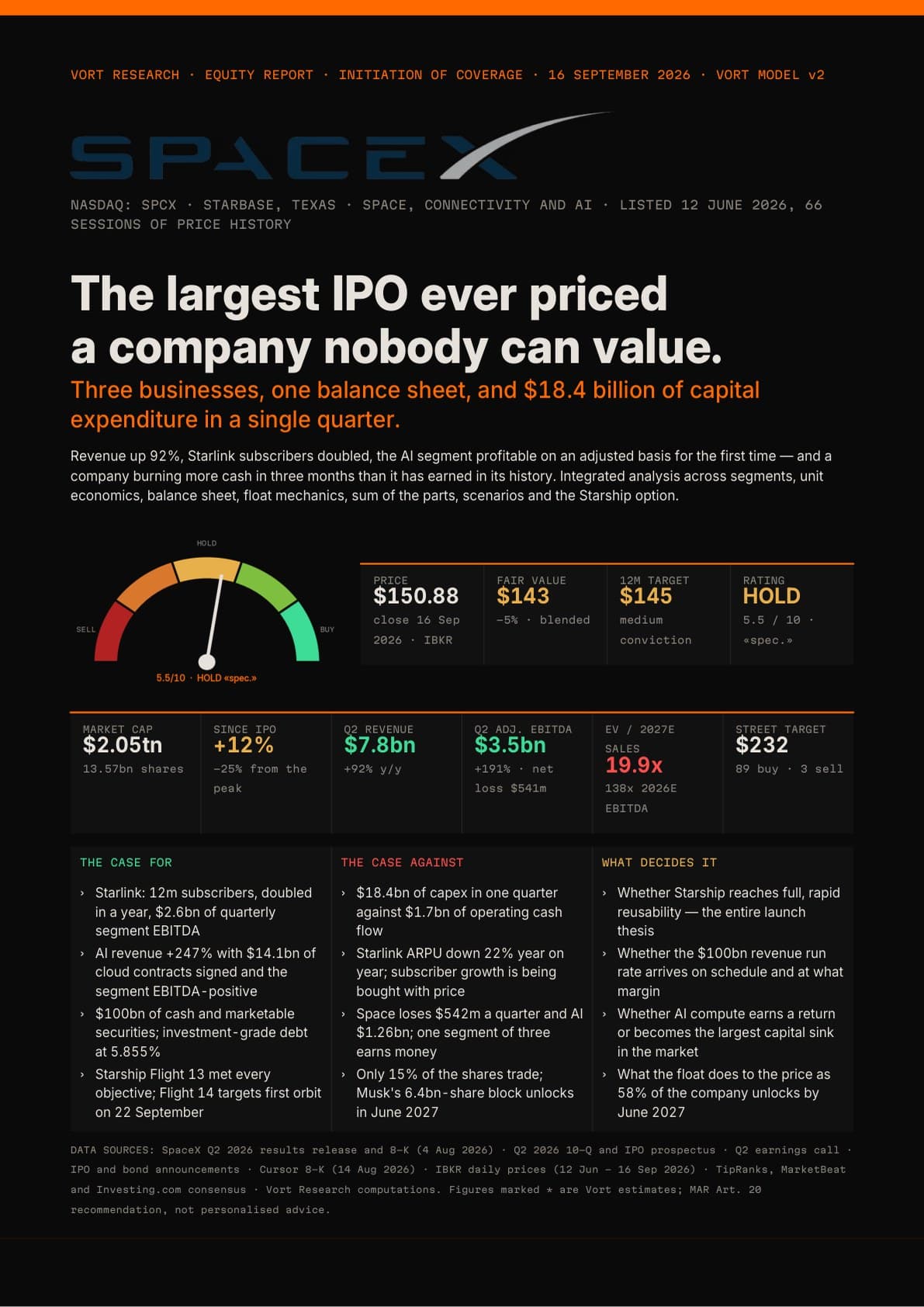
Revenue up 92%, Starlink subscribers doubled, the AI segment profitable on an adjusted basis for the first time — and a company burning more cash in three months than it has earned in its history. Three businesses, one balance sheet, and $18.4 billion of capital expenditure in a single quarter.

Published , 20 pages.

Download the PDFVort+
Share on X
Cover of the Vort report on SpaceX

Rating

Hold

Fair value

$143

Last close

$148.62

Change on the previous close: -2.33% (-$3.54)

Upside to fair value

-4%

from the last close

$150.88 at the report$143 fair value

The US market is closed: the price is the close of October 15, 2026. During the session the quote is delayed up to 15 minutes. The fair value is the report’s, dated September 17, 2026; it does not move with the market. Vort Research provides informational and educational content. It is not personalised financial advice nor a solicitation to invest.

The full report is for Vort+ members.

The rating, the fair value and the reasoning on this page are public. The PDF downloads with Vort+; if you already have it, sign in.

The stock page

12-month target
$145
Rating
HOLD «spec.»
Market cap
$2.05tn

Second quarter 2026, reported 4 August. Source: SEC EDGAR (opens in a new tab)

The thesis in three points

  1. Three businesses on one balance sheet, and only one of them earns money.

    Connectivity — Starlink and Starshield — produced $4.3bn of revenue, up 66%, with 12 million subscribers and $1.66bn of operating income; it is the only segment that earns. AI — the xAI assets acquired in February, Grok, X and the compute estate — produced $2.6bn, up 247%, turned adjusted-EBITDA positive for the first time and consumed $15.8bn of capital in the quarter. Space — Falcon, Dragon and Starship — produced $962m and lost $542m, because Starship development runs through the income statement as research.

  2. Capital expenditure is running at four times operating cash flow.

    The quarter's capex was $18.4bn against $1.7bn of operating cash flow; the first half consumed $28.5bn and generated $3.5bn. The difference is funded by the $85.7bn of IPO proceeds and the $25bn inaugural bond, which is why cash went from $24.7bn to $100bn while the company was losing money. At the current burn — roughly $25bn a quarter of capital against $2bn of operating cash — that balance funds about four quarters before the company must slow down, generate materially more cash, or return to the debt market.

  3. The float is a calendar, and it points one way until June 2027.

    Only 15% of the shares trade today. The IPO placed under 5% of the company into a market that wanted far more, which is why the stock reached $225.64 four days after listing on no news at all; the 6 August lockup expiry more than doubled the float and the shares had already fallen to $104.83 in anticipation. Roughly 1.5bn shares follow on 8 December, and Musk's 6.4bn-share block unlocks on 12 June 2027, taking the float to about 73%. There is no buyback and no dividend: every dated event between now and then adds shares, and none removes them.

revenue, Q2
+92%
Starlink subscribers, doubled
12m
capex in one quarter
$18.4bn
of the shares trade today
15%

The accounts in brief

Second quarter 2026, reported 4 August

Revenue Q2 2026
$7,814m
rising: +92%
Connectivity revenue
$4,291m
rising: +66%
AI revenue
$2,561m
rising: +247%
Adjusted EBITDA
$3,538m
rising: +191%
Net loss
$(541)m
falling: H1 $(4.8)bn
Capital expenditure
$18,369m
falling: $15.8bn on AI
Starlink ARPU
$66 / month
falling: −22% y/y
Cash and securities
$100.0bn
rising: net cash $60.6bn

The analysis

Free summary

Starlink pays for everything

Twelve million subscribers, doubled in twelve months, 1.7 million added in the June quarter alone; consumer revenue up 44%, enterprise and government up 108% on aviation, mobile-carrier and Starshield contracts; a 61% segment EBITDA margin and capex growing far slower than revenue. The FCC's approval of the EchoStar licence transfer added 65 MHz of US spectrum — the scarcest input in the business and the one competitors cannot buy. The line to watch is ARPU: blended revenue per subscriber fell from $85 to $66 in a year, part mix, part competition as Amazon's Kuiper deploys and terrestrial operators discount. Subscriber growth has more than covered the price decline so far; it does not have to. On our estimates Connectivity alone is worth roughly $700bn, about a third of the group, and it is the part of this company that can be underwritten with conventional tools.

$15.8 billion in a quarter: an annuity or a capital sink

The AI segment is thirteen months old inside this company and it is where the case is won or lost. Revenue of $2,561m was up 247% year on year and 213% sequentially on $14.1bn of new cloud service agreements; nameplate compute reached 1.4 GW from 0.4; in August the company closed the $60bn acquisition of Cursor for 389 million shares. Adjusted EBITDA turned positive at $1,146m — by adding back $1.9bn of depreciation on the assets that produced the revenue; on a GAAP basis the segment lost $1.26bn in its best quarter yet. Management's claim of a one-year payback on deployed compute is the single most consequential unverified statement in the file: if it is real, the segment is worth a multiple of what we carry; if utilisation disappoints, depreciation approaches $8–10bn a year within eighteen months and the multiple compresses before the revenue does. The difference between the two answers is roughly $500bn of value, which is why the rating carries a «spec.» suffix.

Starship is the option; the float is the calendar

The launch business itself earns a gross margin above 65%; the Space segment loses money because $1,076m of Starship development ran through the quarter as research. Flight 13 in July met every objective and Flight 14, targeting the first Earth orbit as early as 22 September, is the nearest binary event in our coverage. Achieved, full reusability cuts the cost to orbit by an order of magnitude and every other segment inherits the benefit; not achieved, $4bn a year of research becomes a permanent cost against a launch business earning about $4bn of revenue. We value it as a probability-weighted option, not a cash flow. Around it sits the one certainty on the page: a supply schedule that adds shares at every dated event until June 2027, which makes the cheapest moments to own this company, mechanically, the ones just after a lockup expiry rather than before one.

The $300 billion difference is what the market pays for the decade after 2030 — Starship at scale, orbital compute, Mars. That is a legitimate thing to pay for and an impossible thing to underwrite, which is why this is a HOLD with a «spec.» suffix rather than a SELL.

Vort Research — SpaceX initiation, 16 September 2026

What it does, and how it earns

The business

SpaceX is no longer a launch business with a satellite subsidiary. Since the February 2026 acquisition of xAI it is a holding of three capital-intensive infrastructure businesses that share a balance sheet, a chief executive and a vertical-integration argument: Connectivity (Starlink for consumers, enterprise and aviation, Starshield for government), AI (xAI, Grok, X and the compute estate behind them, now including Cursor) and Space (Falcon and Dragon launch, government missions and the Starship programme). Starlink pays for everything, Space is a research programme with revenue attached, and AI is a construction project with contracts attached.

Where the revenue comes from

  • Connectivity — Starlink consumer, enterprise, mobile; Starshield$4,291m in Q2, +66%
  • AI — xAI, Grok, X and 1.4 GW of compute$2,561m in Q2, +247%
  • Space — Falcon, Dragon, government missions$962m in Q2, +29%
  • Starship — the vehicle in development~$4bn a year of research

The model

The argument is that Starship makes Starlink cheaper, Starlink funds the compute, and compute makes the models that sell through X and Grok. That is coherent. It also means a failure in any one leg is felt by all three, that no segment can be valued apart from the group's cash needs — and that each segment consumes capital on a different clock: Starlink's $1.4bn a quarter pays back, Space's is research, and AI's $15.8bn buys physical compute against contracts signed for a fraction of that value.

The Vort verdict in four lines

This is a qualitative summary and not a recommendation.

  • Growth

    Exceptional

    Consolidated revenue +92%; Starlink subscribers doubled to 12 million; AI revenue +247% with $14.1bn of cloud agreements signed in a quarter and $6.7bn more in the first weeks of the next.

  • Balance sheet

    Fortress

    $100bn of cash and securities against $39.4bn of debt, investment-grade paper at a 5.855% weighted coupon and $47.5bn of backlog. No solvency question and no near-term funding question.

  • Cash burn

    Four to one

    $18.4bn of capex in the quarter against $1.7bn of operating cash flow; two of three segments lose money and the group lost $4.8bn in the first half. The cash funds about four quarters at this pace.

  • Valuation

    Ahead of the parts

    Our sum of the parts is $1.75tn against a $2.05tn market capitalisation: 20× 2027E revenue and 138× this year's adjusted EBITDA. No current-year multiple supports the price; the entire question is whether the $100bn run rate arrives in 2027.

Who it competes with

CompanyWhere it competes
SpaceXThis stockLaunch, satellite broadband and AI compute on one balance sheet
Amazon (Kuiper)The constellation being deployed against Starlink — the source of the ARPU pressure
Terrestrial telecomsDiscounting against Starlink at the connectivity edge; ~$4,000 of EV per subscriber against ~$165,000 here
HyperscalersCompeting for the same AI cloud contracts, with free cash flow behind the compute
Rocket Lab, ULA, Blue OriginLaunch rivals without a reusable heavy vehicle; Starship at scale re-prices the whole market

Moat scores 9.0 out of 10 in our reading — launch capacity, spectrum and a constellation nobody can replicate this decade, reinforced by the 65 MHz of US spectrum that came with the EchoStar licence transfer. The live competitive change is not a rival launcher but Kuiper deploying and terrestrial operators discounting, which is what pulled blended ARPU from $85 to $66 in a year. In AI the group competes with hyperscalers that fund their compute from free cash flow, where SpaceX funds it from an IPO and a bond. Governance is the other structural difference: 82–85% of the voting power sits with one holder, and there is no mechanism by which public shareholders influence capital allocation before 2027, and a limited one after it.

How we value it

The number and the reasoning

Vort fair value

$143

Three anchors, because no single multiple on the consolidated numbers can be right. The sum of the parts values Connectivity at $15bn of 2027E segment EBITDA times 22 ($700bn, $52 a share), AI at $28bn of 2027E revenue times 20 discounted for capital intensity ($560bn, $41), Space at $4.5bn of launch and government revenue times 40 excluding Starship ($180bn, $13), Starship as a probability-weighted option — $1.0tn at full reusability times 25% by 2030 ($250bn, $18) — and $61bn of net cash ($4): $1.75tn, or $129 a share, against $151 in the market. The scenario table applies an enterprise multiple to 2027 revenue: bear, $72bn at 11×, gives $63; base, $100bn at 18×, gives $137; bull, $130bn at 25×, gives $244 — weighted 30 / 45 / 25 for $142. A discounted cash flow is not meaningful — the company will not generate free cash flow before 2028 on any assumption we are willing to publish — so the third anchor is a 2030 bridge worth about $85 today. The published fair value weights the scenarios at 70% and the 2030 anchor at 30%, then adds $12 a share of Starship option value captured by neither: $143, 5% below the $150.88 reference price and well under a consensus of $232 whose range, $117 to $450, is itself the finding. The bridge from the market price runs +$18 for Starlink compounding, +$14 for the AI contracts signed in the quarter, +$4 for net cash and +$12 for the Starship option, then −$22 for the capital burn and −$12 for the float unlocking to 73%. We accumulate below $110, where the operating businesses alone cover the price and Starship comes free, and trim above $190.

Multiples

EV / 2026E revenue
~57×
EV / 2027E revenue
19.9×
EV / 2027E adjusted EBITDA
~44×
Price / book
16.1×

What could go wrong

4 risks, in order

  1. Starship fails to achieve full reusability on schedule

    Medium probability, very high severity. The option is $250bn of our valuation and a quarter of the gap between our number and the market's; a programme failure removes it and leaves $4bn a year of research with no revenue attached. Flight 14 on 22 September, tower-catch attempts and refurbishment turnaround are the checks.

  2. AI compute fails to earn its cost of capital

    Medium probability, very high severity. Depreciation was $1.9bn in the quarter and rising; on $23.6bn of half-year spending it approaches $8–10bn a year within eighteen months, and the segment's positive adjusted EBITDA exists only because that depreciation is added back. Capex above $20bn a quarter without a step-up in contracted revenue would move the rating to SELL regardless of price.

  3. The float unlocks weigh on the price through June 2027

    Certain, high severity. Roughly 1.5bn shares arrive on 8 December, the balance of the pre-IPO investors in the same month, and Musk's 6.4bn-share block on 12 June 2027 with no early-release provision. No buyback offsets any of it. We would not add into the December expiry.

  4. Starlink ARPU keeps falling as Kuiper deploys

    High probability, high severity. Blended ARPU is $66 against $85 a year ago; at 12 million subscribers that is $9.5bn of annualised consumer revenue where $85 would give $12.2bn. ARPU below $60 with net adds under a million a quarter would mean the growth is being bought rather than won, and a 50-point EBITDA margin instead of 61 takes $150bn off the Connectivity line.

In conclusion

The free summary ends here

Where we stand

HOLD

HOLD «spec.», blended fair value $143, 12-month target $145, medium conviction. SpaceX owns the best connectivity business built this decade, the launch capability that makes it possible, and an AI estate assembled at a speed no listed company has matched. It is also spending four dollars of capital for every dollar it generates, earns money in one segment of three, and trades at a market capitalisation $300bn above what its operating businesses and a generous Starship option can justify. That gap is the price of the years after 2030, and it is neither absurd nor underwritable — which is precisely the definition of a hold. We would own this company below $110, where the parts cover the price and Starship comes free, and we would trim above $190, where the 2030 bull case has become the base case. The upgrade trigger is specific and near: an orbital Starship flight on 22 September followed by a December quarter at the $100bn run rate, with AI capex flat and Starlink ARPU stable, takes the base case to $175 and the rating to BUY. Four developments would take it to SELL at any price: a Starship failure that removes the vehicle from the 2027 schedule, AI capex above $20bn a quarter without contracted revenue to match, ARPU below $60 with net adds under a million, or a return to the debt market on materially worse terms than 5.855%. Against 79% average realised volatility and a float that triples by June 2027, the correct position is a small one: 1–2.5%, built in three tranches at $134–138, $118–124 and $105–110, and none of it above $175.

Sources

That was the extract. The full report contains the valuation, the scenarios and what would change our mind.

Download the PDF