Milano––:––apertachiusa. Orario regolare di contrattazione, con le festività di ciascuna borsa: quelle di Borsa Italiana per Milano, quelle del NYSE per New York.
New York––:––apertachiusa. Orario regolare di contrattazione, con le festività di ciascuna borsa: quelle di Borsa Italiana per Milano, quelle del NYSE per New York.
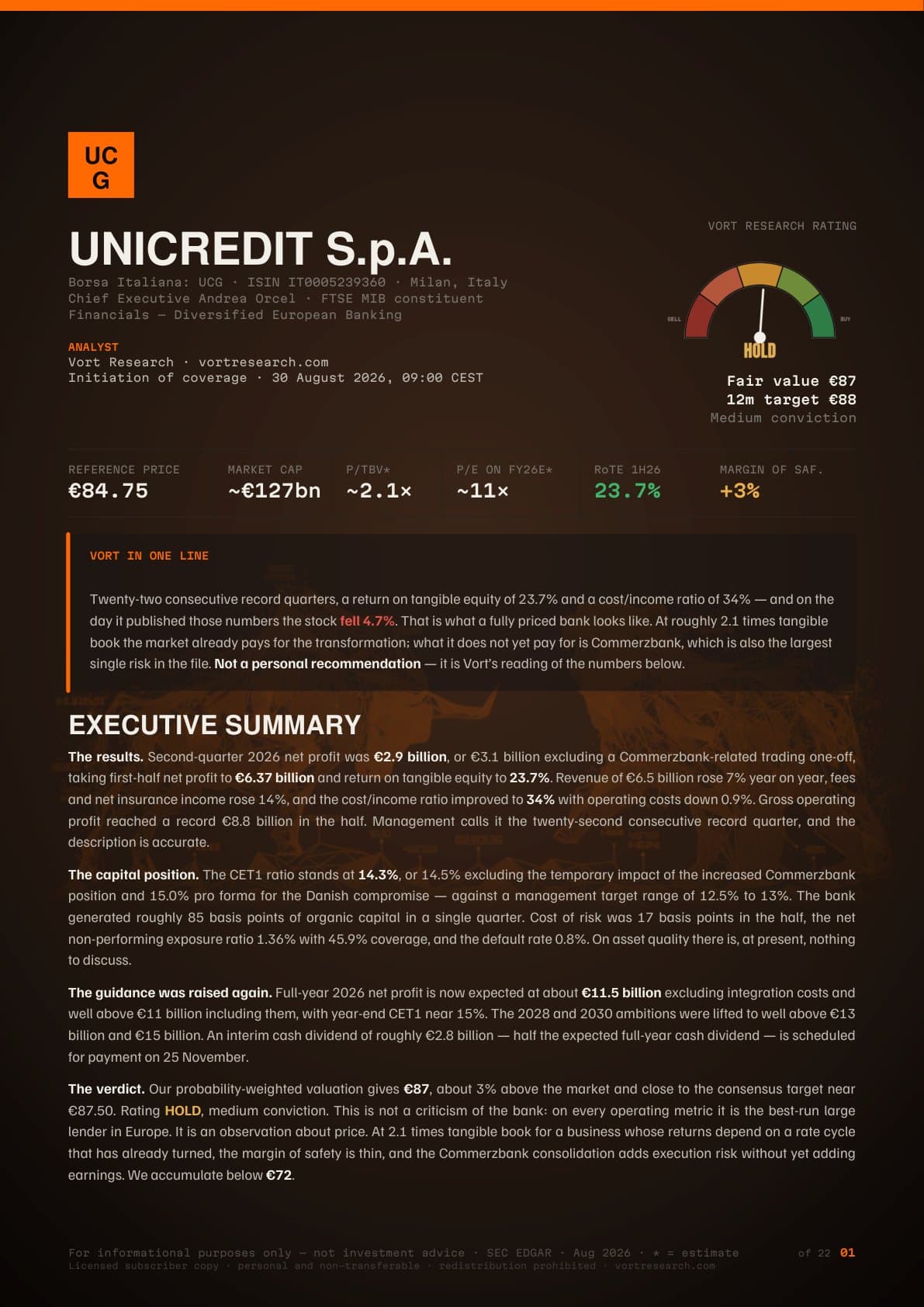
Twenty-two consecutive record quarters, a 23.7% return on tangible equity and a 34% cost/income ratio — and on the day it published those numbers the stock fell 4.7%. At 2.1 times tangible book the market already pays for the transformation.
Le quotazioni live coprono solo i titoli quotati negli USA: per questo titolo il prezzo è quello del report, datato 30 agosto 2026, e il potenziale è calcolato da quello. Il fair value è quello del report del 30 agosto 2026 e non si aggiorna con il mercato. Vort Research fornisce contenuti informativi ed educativi. Non è consulenza finanziaria personalizzata né sollecitazione all’investimento.
Il report completo è riservato agli abbonati Vort+.
Giudizio, fair value e ragionamento di questa pagina sono pubblici. Il PDF e le slide si scaricano con Vort+; se ce l’hai già, accedi.
First-half net profit of €6.37bn, return on tangible equity of 23.7% and a cost/income ratio of 34% — best in class in Europe, and roughly twice the cost of equity. Management calls it the twenty-second consecutive record quarter, and the description is accurate.
The price already says so.
At about 2.1 times tangible book the market pays in full for returns that sit at a cyclical peak: cost of risk at 17 basis points, rates still elevated, costs already cut. On the day those record numbers were published the shares fell 4.7%.
Commerzbank is the swing factor, in both directions.
It is the largest cross-border bank consolidation Europe has attempted in a generation. It is also what spends the capital surplus — CET1 from about 15% to the 13% area — and the management attention that made the machine run.
return on tangible equity, 1H26
23.7%
cost/income ratio
34%
CET1, against a 12.5–13% target
14.3%
total distribution yield
~7.5%
I conti in sintesi
First half 2026, reported 23 July
Net profit FY26E
~€11.5bn
↗ in aumento: +8%
Net profit FY25
€10.6bn
↗ in aumento: +14%
Net profit 1H26
€6.37bn
Revenue 1H26
€13.4bn
Gross operating profit 1H
€8.8bn
↗ in aumento: record
RoTE FY26E
~22%
↗ in aumento: from 19.2%
Cost of risk 1H26
17bps
Net NPE ratio
1.36%
45.9% coverage
L’analisi
Sintesi gratuita
The machine, and why it runs
Revenue of €6.5bn in the second quarter rose 7% year on year, with fees and net insurance income up 14% and operating costs down 0.9%. That combination — growing revenue against falling costs — is what takes a cost/income ratio to 34%, and it is why the returns are where they are.
Capital that has nowhere obvious to go
CET1 stands at 14.3%, or 15.0% pro forma, against a management target of 12.5–13%: roughly €10bn of surplus capital. The bank generated about 85 basis points of organic capital in a single quarter. Surplus of that size is either distributed or spent — and Commerzbank is the proposal to spend it.
Why the fifth force is regulation
For a bank the competitive threat that matters is not substitution but the regulator. Capital requirements, the treatment of insurance holdings, national approval of cross-border deals and the Italian banking tax all move earnings directly, and are all decided outside the company. The 2025 capital decline was driven entirely by one-off regulatory and tax impacts.
The bank has never worked better. The price already says so.
Vort Research — UniCredit initiation, 30 August 2026
Cosa fa, e come guadagna
Il mestiere
UniCredit is a pan-European commercial bank built around Italy, Germany, Austria and central and eastern Europe. It lends, collects deposits, and increasingly earns fees from asset management, payments and insurance — the part of the revenue that survives when rates fall.
Da dove vengono i ricavi
Italy — the home market–quota non indicata
Germany — HypoVereinsbank–quota non indicata
Central Europe — Austria and neighbours–quota non indicata
Eastern Europe–quota non indicata
Il modello
A bank does not have enterprise value or free cash flow in the industrial sense: debt is its raw material, not its financing. It is valued on the relationship between return on tangible equity and cost of equity, expressed as a justified multiple of tangible book.
Il giudizio Vort in quattro voci
È una sintesi qualitativa e non è una raccomandazione.
Operations
✓Best in class
34% cost/income and 23.7% RoTE: no large European bank currently does better.
Capital
✓Strong
CET1 14.3% against a 12.5–13% target, with cost of risk at 17 basis points.
Valuation
×Fully paid
2.1x tangible book for returns at a cyclical peak leaves a thin margin of safety.
Commerzbank
±Unresolved
Accretive if it works, and the end of the capital surplus either way.
Con chi compete
Società
Dove compete
UniCreditQuesto titolo
Pan-European commercial bank — Italy, Germany, CEE
Intesa Sanpaolo
The other Italian large-cap, more domestic and fee-heavy
BNP Paribas
The European scale comparator, lower returns on tangible equity
Banco Santander
Retail scale outside Europe, different risk profile
Commerzbank
The target: German retail and Mittelstand lending
Deutsche Bank
The other German option, still rebuilding returns
European banks are emerging from the rate cycle with capital to deploy, which is the same force that makes Commerzbank contested. Rivalry is intensifying at exactly the moment the sector has the money to act on it.
Come lo valutiamo
Il numero e il ragionamento
Fair value Vort
€87
Probability-weighted across three scenarios: bear €58 at 15% return on tangible equity, base €90 at 20%, bull €108 at 22% with Commerzbank delivering — weighted 25 / 50 / 25. That gives €87, about 3% above the market and close to the consensus target near €87.50. The bear case is not a crisis, it is normalisation: rates settle lower, deposit competition returns, cost of risk rises from 17 to about 45 basis points. We accumulate below €72.
Multipli
P / tangible book
~2.1x
P/E on FY26E
~11x
Tangible book per share
~€41
Total distribution yield
~7.5%
Cosa può andare storto
4 rischi, in ordine
01Cost of risk normalises above 40 basis points
At 17 basis points the cost of risk can only go one way. The bear case assumes about 45, which is not a crisis but is enough to take return on tangible equity to the mid-teens — and the multiple with it.
02Deposit repricing erodes net interest income
In banking the suppliers are depositors, and their power rises as rates fall and a current account stops being the only option. The structural hedge is built to offset this; whether it offsets it fast enough is the open question.
03Commerzbank fails, or succeeds and disrupts
German approval is not assured and the politics are live. But the symmetrical risk is worse: a bank running at twenty-two consecutive records is a machine, and integrating a large competitor is the classic way such machines are disrupted.
04Multiple compression from 2.1 times tangible book
The one risk that has nothing to do with the company. If the European sector de-rates, a bank priced at the top of the range falls furthest, whatever its own numbers say.
In conclusione
La sintesi gratuita finisce qui
Dove ci posizioniamo
HOLD
Fair value €87, 12-month target €88, medium conviction. This is not a criticism of the bank: on the evidence it is the best-run large lender in Europe. It is an observation about price. At 2.1 times tangible book, for returns sitting at a cyclical peak, the margin of safety is thin and Commerzbank adds execution risk without yet adding earnings. Same number as consensus, opposite conclusion. Accumulate below €72.